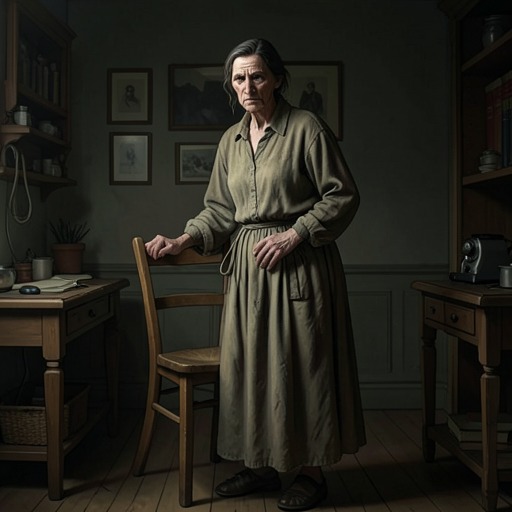
The wife of the son of the Hengluye family
Journey to the End of the NightThe Henrouille daughter-in-law is a central participant in the attempt to kill Grandma Henrouille, a scheme presented as a way to remove an inconvenient family member while making her death look accidental. When the plan fails, she is less distressed by the danger than frustrated by its failure, and she tries to silence the old woman’s accusations. Later, she summons Ferdinand Bardamu back to the house, renewing his involvement in a household whose concealed violence has not been resolved.
Role in the attempted murder
The daughter-in-law is involved in a plan with her husband and Robinson to kill Grandma Henrouille. As Ferdinand Bardamu recognizes when speaking with Robinson, the arrangement is not simply a matter of building a rabbit hutch: the family intends to use it to murder the old woman. Robinson describes the scheme as one worked out between himself and the couple, and Bardamu fears that he is being drawn into a crime for their benefit.
The plot relies on the old woman’s movements and on the neighborhood’s existing belief that she is mentally unwell. The conspirators intend to send her to feed the rabbits one evening and place fireworks so that they will explode when she touches the hutch door. They expect the neighbors to accept her death as an accident, reasoning that she had been warned away from the rabbits and had disobeyed. The daughter-in-law’s role is thus part of a calculated effort not only to kill Grandma Henrouille but to arrange in advance how the death will be understood.
The failed scheme and its aftermath
The attempt fails, and Grandma Henrouille survives. When Bardamu arrives at the house, the daughter-in-law ushers him straight inside, where he encounters the old woman making accusations before he has time to prepare. The daughter-in-law then tries to hush her, concerned that passers-by may hear what happened.
Her reaction is notably practical. She appears put out that the scheme has miscarried rather than overcome with remorse, and the narrator observes that the failure has not changed her view of the situation. She still considers herself right. Meanwhile, Grandma Henrouille’s accusations threaten to expose the conspiracy to the neighbors and possibly to the police. The family’s immediate concern becomes preventing a public spectacle and keeping outsiders from investigating.
The failed attack changes the old woman’s condition in an unexpected way. Although the attempt has nearly killed her, Bardamu sees that surviving it has revived her vitality after years of confinement in the garden. Her renewed energy makes her harder for the household to manage: she denounces the people who tried to kill her and turns the risk of exposure into leverage over them. The daughter-in-law’s effort to hush her therefore signals not a restored domestic peace but a new struggle over who controls the story of the attack.
Managing the household’s exposure
After the failed murder, Bardamu treats Robinson’s injuries and helps the family keep the incident from drawing attention. The blinds in Robinson’s room are kept closed, and the household gives neighbors misleading explanations when they ask after him. The daughter-in-law is one of the people who must contend with Grandma Henrouille’s accusations outside, where the old woman’s visibility threatens to bring scrutiny to the house.
Bardamu describes the old woman’s accusations as a source of blackmail. The household takes turns trying to calm her, while balancing the danger that forceful treatment will look like intimidation against the ineffectiveness of gentleness. The daughter-in-law is therefore caught in the consequences of the scheme she helped arrange: she must live alongside its intended victim, whose survival and renewed will to speak make concealment increasingly precarious.
The family later seeks to remove both Grandma Henrouille and Robinson from the house. When months of waiting for a place with the Sisters seem intolerable, Abbé Protiste proposes a quicker arrangement in Toulouse. Bardamu agrees to help persuade Robinson to go south with the old woman, and the plan promises a commission for both the priest and the doctor. The daughter-in-law is included in this wider effort to have the pair leave, though the evidence does not establish that she devised the Toulouse arrangement herself.
Bardamu’s return to the house
Some time later, Bardamu wanders back toward the Henrouilles’ house, despite his unease about revisiting it. In the rain, he hesitates across the street, but the daughter-in-law sees him, opens the door, and motions him inside. Her prompt recognition and insistence overcome his reluctance; she calls him by name and asks him to hurry.
She tells Bardamu that her husband has been ill for two months and is getting worse. When he asks about Robinson, she initially evades the question, then claims that Robinson and Grandma Henrouille are both well and that their business in Toulouse is going well. She quickly shifts the conversation back to her husband and presses Bardamu to examine him, citing his devotion to the family and her husband’s refusal to see another doctor. Bardamu suspects that her account is incomplete, but his curiosity leads him upstairs.
Her return to the narrative thus repeats an earlier pattern: she calls on Bardamu when the household needs his help, while withholding or redirecting information that might expose what is happening. The earlier conspiracy has already shown the cost of that secrecy; the later visit leaves him once more inside the family home, faced with illness and unanswered questions.